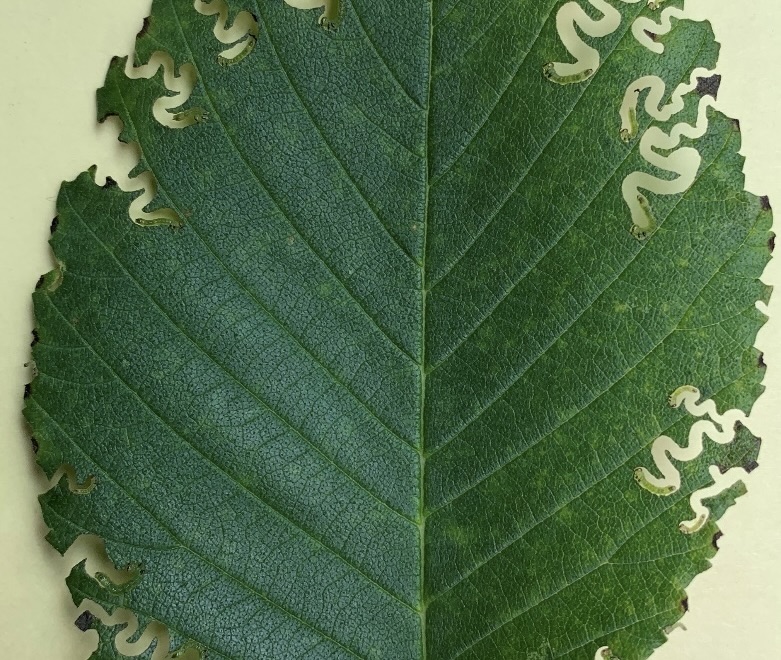
Officials have confirmed that a new invasive insect, the elm zigzag sawfly, has been gnawing on elm trees in Vermont, including in Alburg, North Hero and Milton.
The bug, which chews distinctive zigzag patterns into leaves — and can completely defoliate elm trees — is native to east Asia. It made its first appearance in North America in 2020, in Quebec, and officials have since identified the insect in six states, according to Josh Halman, forest health program manager with the Vermont Department of Forests, Parks and Recreation.
A visitor to Vermont from Quebec tipped off officials to the insect’s presence last fall by posting a photo of the zigzag-shaped holes in the leaves on the app iNaturalist. While officials found the damaged leaves, they couldn’t locate the larvae, so they returned to collect samples last spring.
Those samples, sent to the U.S. Department of Agriculture Plant Protection and Quarantine program, recently confirmed the bug’s existence in Vermont.
Because the bug is so new to the continent, scientists haven’t yet identified a good way to control it. While pesticides effectively kill the sawfly’s larvae, they also harm beneficial, native critters that live in and near elm trees.

Scientists don’t yet understand the full potential impact of the bug, either.
“They strip the tree of their foliage,” Halman said. “Most trees are able to refoliate once they get defoliated one season. The longer-term impacts of repeated defoliation are kind of unknown at this point.”
Asked whether the bug’s presence in Vermont could be related to climate change, Halman said the bug’s arrival, likely south from Canada, wouldn’t be connected to warming temperatures, but longer summers may help the bug thrive.
“This is a species that can produce multiple generations per season,” he said. “So if we have warmer and longer summers, then that’s a larger window for this population to build and spread.”
Other invasive insects around the state have also had an impact on Vermont trees — the emerald ash borer, for example, has been spreading in Vermont since 2018, and spongy moth caterpillars caused wide-scale destruction to forests in the Champlain Valley in 2021.

Halman said state officials are on their guard for beech leaf disease, caused by the presence of a nematode species. It’s already in Connecticut, New Hampshire, New York and Massachusetts, and it can kill beech saplings and hurt or kill mature trees.
They’re watching for the spotted lanternfly, which has been harmful in some parts of the Northeast, too, but officials are slightly less concerned because Vermont doesn’t have many trees of heaven, a plant the lanternfly favors.
So far, officials have found the elm zigzag sawfly only in the northwestern region of the state, but Halman asked that anyone who finds evidence of the bug — or any other invasives — swiftly report their finding to vtinvasives.org.